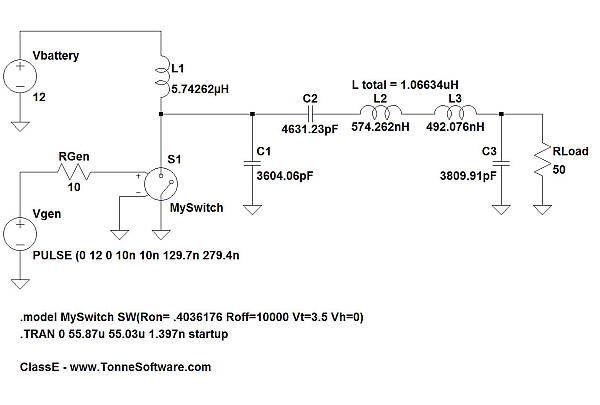
This program simplifies the design of the single-ended class E amplifier. Operation is intuitive and encourages circuit
exploration.
We are now at revision 2.08.
- Each of the six design parameters can be specified using a freeform entry scheme.
- Each of those parameters can be "tuned" by clicking on the up and down buttons; see the graphic below. This allows
instant feedback regarding what parameter affects what schematic trait.
- Each parameter has a default value and entries are checked to reduce the probability of ridiculous results.
- As an option the program will read a user-entered load value and match the amplifier to that value of load using an
added L-network.
- Data are written automatically to a "last session" file at program exit time, allowing a simplified program
restart.
- The program also writes a schematic (.ASC) file to drive the LTspice simulator from Linear Technology. (Tonne
Software has no connection with Linear Technology.)
This program uses the revised equations presented in "QEX" for Jan/Feb 2001. They are close to but seem to be more
accurate than the more-commonly used set of equations presented in "RF Design" for Summer, 1980.